
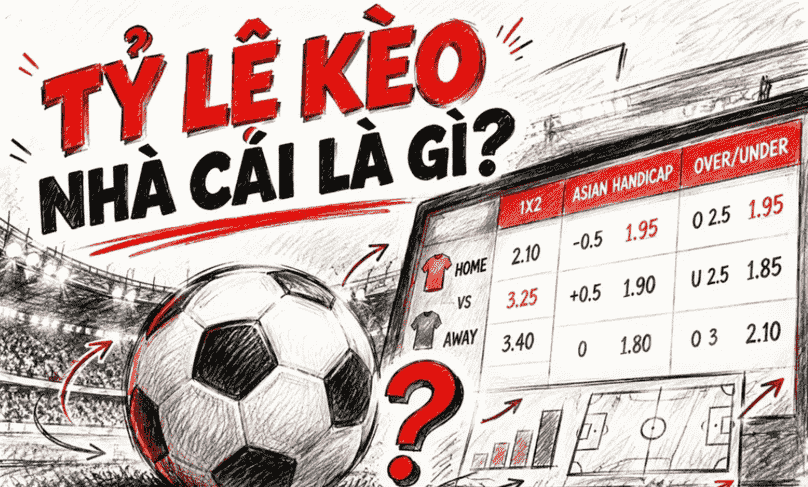
Football odds are commonly used to represent different possible outcomes and the conditions attached to a market. For newcomers, the numbers may initially seem difficult to interpret, especially when several formats appear around the same match. A useful starting point is to understand what each market represents rather than trying to memorize every number. Match context also matters. Team form, injuries, venue, schedule congestion, and tactical matchups can all affect how a fixture is assessed. Odds should therefore be treated as one source of information rather than a guarantee about what will happen on the pitch.
Understanding the basic purpose of football odds
When examining tỷ lệ kèo, readers should first identify the market and the outcomes being represented. Different markets answer different questions about a match, so comparing numbers without understanding their purpose can create confusion. Learning the basic structure makes later analysis much easier.
Start with the market type
A match can be viewed through several markets, each focusing on a different aspect of the game. Some relate to the final result, while others concern goals or a specified handicap.
Before interpreting a number, confirm exactly what event or outcome it represents. This simple step prevents many misunderstandings.
Separate odds from predictions
Odds should not be interpreted as a certain prediction of the final score. Football contains substantial uncertainty, and unexpected events can alter a match quickly.
A red card, injury, penalty, or individual mistake can change conditions even when the pre match analysis was reasonable.
Consider the timing
Numbers available several days before a match may differ from those shown shortly before kickoff.
New information about injuries, lineups, scheduling, or other developments can change the market context. Readers should therefore note when the information was observed.
Tỷ lệ kèo là gì in practical football analysis.
Readers asking tỷ lệ kèo là gì are essentially trying to understand how betting markets communicate conditions and possible outcomes. The most useful approach is to combine this knowledge with football analysis instead of reading numbers in isolation.
Review recent team form
Recent results provide useful context, but wins and losses alone are not enough. The strength of the opposition should also be considered.
A team may have several victories because it faced weaker opponents, while another may have poor results after a particularly difficult schedule.
Check home and away performance
Some teams perform very differently depending on the venue. Home and away records can therefore reveal information hidden by the overall league table.
This does not mean home teams should automatically be rated higher. The opponent’s away performance remains equally important.
Study player availability
Missing players can alter tactics and team balance. The effect depends on the player’s role and the quality of the replacement.
Official lineups close to kickoff provide more reliable information than early speculation about who may or may not start.
Building a structured approach
Instead of changing methods from one match to another, readers can create a consistent checklist. Form, venue, player availability, rest days, and tactical characteristics are useful categories.
Avoid relying on one statistic
League position can be informative but does not describe every recent development. Head to head records also have limitations when squads and coaches have changed.
Using several relevant indicators generally provides better context than searching for one decisive statistic.
Review changes carefully
When odds move, it is useful to check whether new football information has appeared.
Movement alone should not automatically replace an existing assessment. The reason behind the change is more informative than the movement itself.
Keep expectations realistic
No analysis removes uncertainty from football. Even a strong data based assessment can be affected by unpredictable events.
If betting is involved, spending limits should be decided in advance and kept separate from essential finances.
Conclusion
Understanding football odds begins with knowing what each market represents and then placing that information within the context of the match. Recent form, venue, player availability, scheduling, and tactical characteristics all contribute useful evidence. Odds are best treated as informational signals rather than guarantees. A consistent analytical process can help readers interpret football markets more clearly while maintaining realistic expectations about uncertainty.