
Total penalties scored is becoming an important statistical factor in modern football analysis and betting strategies at kèo nhà cái. Understanding how penalties influence match outcomes can give players a clearer edge in prediction models. This guide explores key insights to help you interpret penalty-related data more effectively.
What does total penalties scored mean in football analytics
Understanding statistical indicators at kèo nhà cái is essential for improving football prediction accuracy and building stronger analytical models. One important metric in modern football data is total penalties scored, which reflects both match dynamics and refereeing influence.
Basic definition of total penalties
This metric represents the total number of penalty kicks successfully converted into goals during a match or a defined period.
- It only counts penalties that result in goals, excluding missed or saved attempts.
- The statistic is used to evaluate scoring efficiency from penalty situations.
- It helps analysts measure how often penalties directly impact match outcomes.
Why this metric is important in football analysis
Total penalties scored provides deeper insight into how matches are influenced by critical game-changing moments.
- It highlights the role of penalties in shaping final scorelines across different leagues.
- Analysts use it to evaluate referee tendencies and attacking pressure levels.
- It can indicate how frequently teams convert high-pressure scoring opportunities.

What does total penalties scored mean in football analytics
How penalties affect match statistics and predictions
Penalty data can significantly influence predictive models used in football betting analysis.
- Matches with higher penalty frequency often show unpredictable scoring patterns.
- Teams with strong attacking styles may generate more penalty opportunities.
- This information helps refine over/under and goal-related betting strategies.
Refereeing influence on penalty statistics
Referees play a major role in determining how often penalties are awarded in matches.
- Some referees are statistically more likely to award penalties based on their officiating style.
- VAR technology has increased the accuracy and frequency of penalty decisions.
- These factors directly affect total penalties scored across competitions.
Key factors influencing total penalties in matches
Understanding what drives penalty decisions is essential for building accurate football predictions and improving analytical depth. The metric total penalties scored is heavily influenced by tactical, physical, and refereeing elements in each match.
| Factor | Explanation |
| Attacking pressure | Teams that attack aggressively inside the box create more contact situations, increasing penalty chances. |
| Defensive style | High-risk defending or frequent sliding tackles can lead to more fouls in dangerous areas. |
| Refereeing tendency | Some referees are more strict and call penalties more frequently than others based on officiating style. |
| VAR intervention | Video assistant referees increase the likelihood of penalties being awarded after review decisions. |
| Match intensity | High-stakes matches often have more physical duels, which can lead to penalty incidents. |
| Player skill level | Skilled attackers are more likely to draw fouls inside the penalty area through dribbling and positioning. |
| Tactical formations | Certain formations create crowded box situations, increasing the probability of accidental fouls. |
How refereeing style impacts total penalties scored trends
Refereeing style plays a crucial role in shaping match outcomes and directly influences statistical trends across competitions. When analyzing total penalties, it is important to consider how individual referees interpret contact situations differently, especially when studying matches on kèo nhà cái.
- Some referees adopt a strict approach and are more likely to award penalties for minimal contact inside the box. This increases the overall frequency of penalty decisions in matches they officiate.
- Other referees prefer a more lenient style and allow more physical play before calling fouls. This can significantly reduce the number of penalty awards even in high-pressure matches.
- VAR usage also interacts with refereeing style and can either reinforce or overturn on-field decisions. Referees who rely heavily on VAR tend to produce more confirmed penalty outcomes.
- Referee consistency across seasons can affect long-term trends in total penalties scored. Analysts often track these patterns to improve prediction accuracy over time.
- Psychological control of matches is another factor, as some referees manage games tightly to prevent escalation. This can indirectly influence how often penalty situations are judged or ignored.
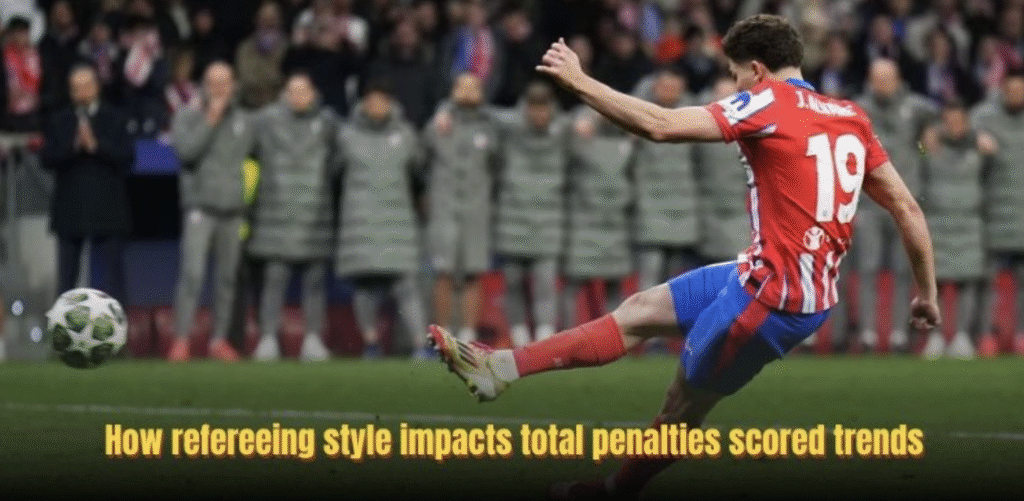
How refereeing style impacts total penalties scored trends
Statistical methods to analyze total penalties effectively
Accurate football prediction relies heavily on structured statistical approaches that help interpret match events more precisely. When studying total penalties scored, combining multiple analytical methods can significantly improve decision-making quality, especially for users of kèo nhà cái.
Descriptive statistics for penalty trends
This method focuses on summarizing historical data to identify general patterns in penalty occurrences.
- It calculates averages of penalties per match across leagues or seasons.
- Helps identify whether a competition tends to have high or low penalty frequency.
- Provides a basic foundation for deeper predictive modeling.
Probability distribution analysis
This approach evaluates how likely penalty events are to occur within a given dataset.
- Uses historical match data to estimate the probability of penalty awards.
- Helps determine whether penalty events follow predictable or random patterns.
- Supports more accurate forecasting models for betting strategies.
Regression modeling for predictive insight
Regression techniques help determine which variables most strongly influence penalty outcomes.
- Identifies relationships between attacking style and penalty frequency.
- Measures impact of referee behavior on total penalty trends.
- Allows analysts to build data-driven prediction systems.
Expected value calculation method
This method evaluates whether betting opportunities related to penalties are statistically profitable over time.
- Combines probability and payout ratios to estimate long-term returns.
- Helps players assess risk versus reward in penalty-related markets.
- Reduces emotional decision-making in football betting strategies.
3-sentence analytical overview
Statistical methods provide a structured way to interpret total penalties scored in modern football analysis. By combining historical data, probability models, and predictive techniques, analysts can improve accuracy significantly. When applied correctly at kèo nhà cái, these methods create a more reliable foundation for football betting decisions.
Statistical methods to analyze total penalties effectively
Conclusion
Understanding total penalties scored helps players gain deeper insight into how key match events influence football outcomes. By combining statistical analysis with real match observation, predictions become more structured and reliable. Applying these insights at truc tiep keo nha cai can significantly improve long-term betting decisions.