A punter who understands 1X2, BTTS and Asian handicap markets can still misread an online card game. A familiar name such as poker, blackjack or rummy does not guarantee familiar rules. Two tables may use the same deck while applying different rankings, actions, time limits and settlement procedures.
The useful habit that transfers from football betting is not prediction. It is precision. Just as a bettor should read the exact market rather than rely on a shortened label, a card-game player should identify the variant, table format, full stake and winning condition before joining.
The objective is not to find a guaranteed winning table. It is to understand what one round costs and how the result will be settled.
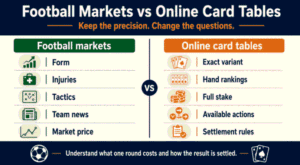
Key differences between football markets and online card tables
Identify the Exact Variant Before Joining
Broad labels can hide important differences. Poker variants can change the number of private cards, betting rounds and hand-construction rules. Rummy-style games can change the number of cards dealt, valid melds, drawing procedure and scoring of unmatched cards. Dealer-based games may also use different rules for drawing or resolving a tie.
Before entering, confirm:
- The full variant name.
- The number of cards dealt.
- The order of valid hands or combinations.
- The actions available during a turn.
- The rule used when two results appear equal.
Checklist for identifying the exact online card game variant
This is comparable to football markets. A home win, draw no bet and Asian handicap +0.25 may support the same team, but they do not settle in the same way. In card games, a “straight”, “valid set” or “special hand” only has meaning within the selected rules.
Separate Platform Checks From Table Rules
Account and access checks should happen before money or personal information is involved. The domain, login route, account-recovery process, payment instructions, mobile access and support channels should be clear enough to review in advance.
For readers specifically researching the brand, the website Uy88 provides a starting point for checking registration, login, payment and account instructions before proceeding.
That information does not replace the rules inside a card game. Two tables with similar names may use different controls or settlement logic. The lobby shows where a game is located; the rule panel explains how it works.
Never share a password, PIN, card security code or active one-time code with someone claiming to resolve an ordinary account issue.
Read the Round From Entry to Settlement
A card round is easier to understand when it is broken into stages:
- The base stake and any optional selections are confirmed.
- Cards are dealt or displayed.
- The player receives a decision window.
- Actions are locked when the timer ends or confirmation is submitted.
- Hands, points or combinations are compared.
- The result is settled and the balance is updated.
A player may understand the cards but still miss the timing. A correct action submitted after the countdown reaches zero may not be accepted. A preselected action may also be applied automatically when the turn begins.
On mobile, check for quick-action, repeat-bet or automatic controls. If the screen responds slowly, do not tap repeatedly.
It is also essential to identify the opponent structure. Some games compare the player with a dealer or fixed rule. Others compare several seats, while certain digital products use a points target. Beating another visible hand does not automatically mean the table has been beaten; the comparison and tie rules decide the result.
Check Hand Rankings and Exceptions
The same cards can be treated differently across variants. An ace may count high, low or either way. Suits may be equal in one game and ranked in another. A sequence may need to follow a suit, colour or regional rule. Some games compare combinations, while others calculate points or unmatched cards.
Readers who need a broader view of the available categories and table labels can use the UY88 card game guide, while the rules inside the selected title remain the final reference for rankings, actions and settlement.
Before playing, check whether suits matter, how an ace is counted, what breaks a tie and whether a special hand overrides the normal order. Do not use a ranking chart from another game merely because the cards look similar.
For example, two hands may both appear to contain a sequence. In one variant, both are valid. In another, one fails because the cards are not the same suit or the ace is being used in an invalid position. The variant, not the visual similarity, defines the result.
Confirm the Full Cost of One Round
The table minimum is not always the maximum amount that can be committed. A base stake may be followed by a raise, double, split, insurance option or side bet, depending on the game.
Suppose an illustrative table begins with a base stake of 50 units. The player adds a 20-unit side bet and later chooses an action requiring another 50 units. Total exposure for the round becomes 120 units, not 50.
How to calculate the full cost of one online card game round
This is the card-table equivalent of reading the complete football bet slip rather than looking only at the headline odds. Before confirming, identify the base stake, optional bets, additional actions and maximum possible exposure.
Side bets must be treated separately from the main game. A strong main hand does not automatically make a pair, tie or bonus selection successful. Each selection has its own trigger and payout table, and a large multiplier may apply only to a rare condition.
Control Speed and Session Exposure
Digital card games can complete rounds much faster than physical tables. Short countdowns, quick dealing and remembered stakes can increase the amount committed within a brief period.
The unit discipline used for football betting should not disappear simply because card rounds settle faster. Set three limits before the first round:
- Money limit: the maximum loss that will not affect essential spending.
- Time limit: the point at which the session ends, regardless of the result.
- Stake limit: the highest total exposure allowed for one round.
A recovery target is not a real limit. “I will stop when I get back to even” can extend a session indefinitely. Check whether the table remembers the previous stake, repeats side bets or enables an automatic action after reconnecting.
Speed is a convenience feature, not evidence that a decision is better.
Use History for Verification, Not Prediction
Football form can be relevant because teams, tactics and injuries carry information from one match to another. A sequence of previous card results does not provide equivalent evidence that a particular hand is “due”.
A recent run of low cards, dealer wins or losing rounds is not a reliable reason to increase the next stake. Past results are useful for checking what happened, not for guaranteeing what happens next.
Keep a short record of the game, variant, starting balance, highest stake, ending balance and time spent. This shows whether limits were followed and preserves details for a settlement review.
If a round freezes after the stake is accepted, do not repeat the action immediately. Wait for the balance to update, check any available game history or round reference and save the time, stake and displayed status. Support should not require a password or active OTP to investigate a normal settlement query.
Final Pre-Table Checklist
Before joining an online card table, confirm that:
- The account route and domain have been checked.
- The exact variant and opponent structure are known.
- Hand rankings, tie rules and available actions are understood.
- The full possible cost of one round is visible.
- Side bets are separated from the main selection.
- Money, time and stake limits are already set.
Final checklist before joining an online card table
If one point is unclear, leaving the table is a valid decision.
Conclusion
Football markets and online card tables require different forms of analysis. Team news and price movement may help assess a match, but they do not explain a card-game variant, hand ranking or table settlement. The transferable skill is discipline: read the exact rule, confirm the full exposure and understand how the result is decided before acting.
Online card games involve financial risk and uncertain outcomes. Treat them as entertainment, use only money you can afford to lose, follow the age and gambling laws that apply where you live, and stop when the activity is no longer manageable.